As a parent in New Zealand, you've likely heard about Montessori toys and their remarkable impact on child development. But with countless options flooding the market, how do you choose authentic Montessori toys NZ families can trust? More importantly, which ones are actually worth your investment?
This comprehensive guide cuts through the marketing noise to help you select the best Montessori toys NZ has to offer—with a special focus on locally handcrafted wooden toys that embody true Montessori principles.
What Makes a Toy "Montessori"?
Not every wooden toy qualifies as a Montessori toy. Authentic Montessori toys NZ parents should look for share these essential characteristics:
- Natural materials: Wood, metal, fabric—never plastic. Natural materials provide authentic sensory experiences and connect children to the real world.
- Single purpose: Each toy teaches one skill or concept at a time, allowing focused learning without distraction.
- Reality-based: Montessori toys represent real objects and scenarios, not fantasy characters or flashing lights.
- Self-correcting: The design allows children to recognize and fix their own mistakes, building independence.
- Beautiful and well-crafted: Quality construction teaches children to respect their belongings and appreciate beauty.
Dr. Maria Montessori believed children learn best through hands-on exploration with purposeful materials. The best Montessori wooden toys facilitate this natural learning process.
Why Choose Montessori Toys Made in New Zealand?
When searching for Montessori toys NZ parents have a unique advantage: access to locally handcrafted toys made from native timbers that imported mass-produced options simply cannot match.
The NZ-Made Difference
Superior timber quality: Native New Zealand woods like Kauri, Rimu, and Macrocarpa offer exceptional durability, beautiful grain patterns, and natural warmth that enhances tactile learning.
Authentic craftsmanship: Local artisans create each piece by hand, ensuring quality control and attention to detail impossible in factory production.
Sustainability: Choosing NZ-made Montessori toys reduces carbon footprint from shipping and supports sustainable forestry practices in our own backyard.
Safety assurance: Local craftsmen adhere to strict NZ safety standards, using food-safe finishes and ensuring no small parts or sharp edges.
Supporting local economy: Every purchase supports New Zealand families and keeps traditional woodworking skills alive in our communities.
Best Montessori Toys NZ by Age Group
Montessori Toys for Babies: 0-6 Months
During the first six months, babies are developing visual tracking, grasping reflexes, and beginning to explore textures. The best Montessori toys NZ offers for this age focus on simple sensory experiences.
Wooden grasping toys: A smooth, single wooden ring made from native Rimu provides the perfect weight and texture for tiny hands. The natural wood scent and warmth engage multiple senses simultaneously.
High-contrast mobiles: While not always wooden, black and white mobiles support visual development. Pair with wooden elements for tactile exploration once baby shows interest.
Texture balls: Soft fabric balls with varied textures introduce different sensory experiences. Choose natural materials like wool or cotton.
Key principle: Less is more. Babies this age need just 2-3 carefully chosen toys available at a time to support focused exploration.
Montessori Toys for Babies: 6-12 Months
As babies become more mobile and dexterous, Montessori toys NZ parents choose should support their emerging skills.
Wooden teething rings: A handcrafted Rimu teething ring provides safe relief while developing the pincer grasp. Natural wood is antibacterial and safe for constant mouthing.
Object permanence boxes: A simple wooden box with a hole and ball teaches cause-and-effect while supporting hand-eye coordination.
Wooden rattles: Native New Zealand timber rattles produce gentle, natural sounds—not the harsh plastic noise that overstimulates. The weight helps develop proprioception.
Stacking rings: A wooden peg with graduated rings teaches size discrimination and problem-solving. Choose solid wood pieces without paint for the purest sensory experience.
Push toys: Around 10-12 months, a sturdy wooden push toy supports emerging walking skills. Look for simple designs without added noise or lights.
Montessori Toys for Toddlers: 1-2 Years
Toddlers are refining gross and fine motor skills while developing language and cognitive abilities. The best Montessori toys NZ craftsmen create for this age support independence and practical life skills.
Wooden puzzles: Single-piece puzzles with knobs help toddlers practice the pincer grasp while learning shape recognition. Progress to 3-5 piece puzzles as skills develop.
Nesting boxes: Wooden boxes that fit inside each other teach size relationships and spatial awareness. Handcrafted sets from native timber become family heirlooms.
Simple wooden blocks: Unit blocks made from uniform wood pieces support mathematical thinking, creativity, and engineering concepts. A basic set of 10-15 blocks is perfect for this age.
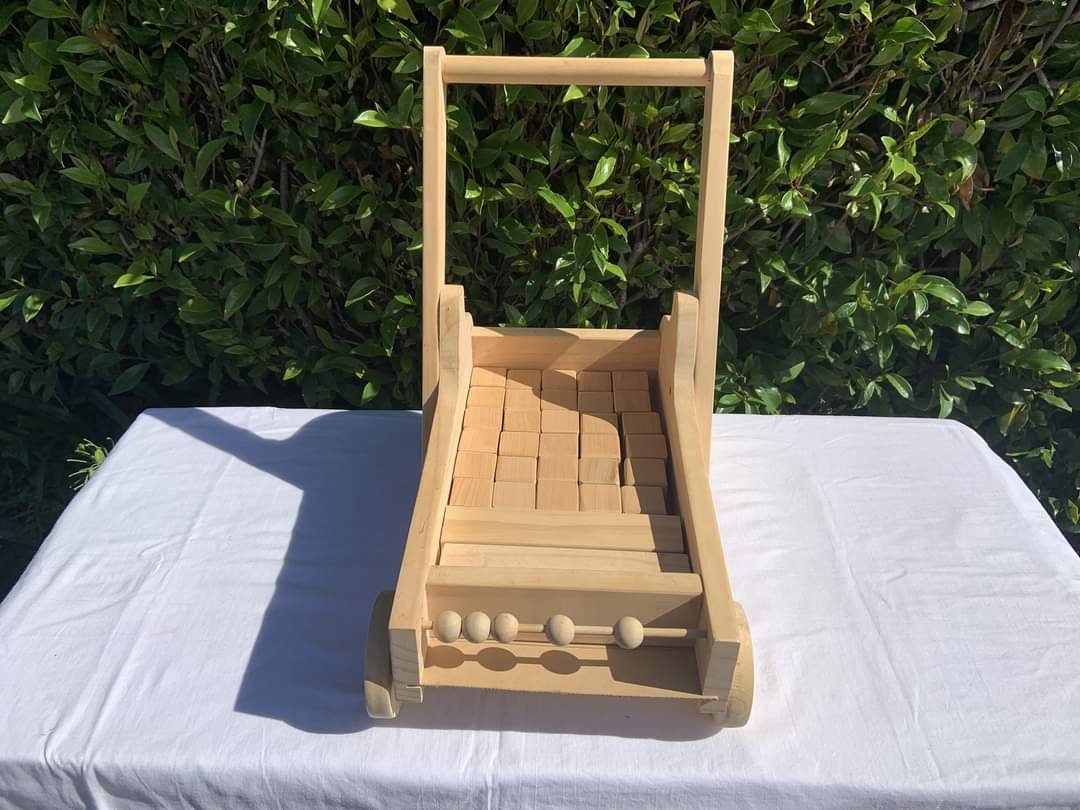
Wooden trolley and blocks: A push trolley filled with wooden blocks combines gross motor practice with purposeful work. Choose one handcrafted from Pine or Macrocarpa for durability.
Practical life tools: Child-sized wooden spoons, bowls, and tools allow toddlers to participate in real activities—cooking, gardening, cleaning.
Montessori Toys for Preschoolers: 2-3 Years
Preschoolers are ready for more complex challenges. Montessori toys NZ for this age should introduce early academic concepts through hands-on manipulation.
Wooden building blocks: Expand to 30-50 blocks in various shapes. Native timber blocks from Kauri or Rimu provide satisfying weight and stability for elaborate constructions.
Sorting and matching games: Wooden boards with shapes, colors, or sizes teach classification skills foundational to mathematics.
Simple wooden vehicles: A handcrafted dump truck or train made from New Zealand Pine supports imaginative play while teaching mechanical concepts.
Threading activities: Large wooden beads and laces develop fine motor skills and concentration. Choose beads made from hardwood for durability.
Wooden puzzles (8-12 pieces): More complex puzzles challenge problem-solving abilities and spatial reasoning.
Montessori Toys for Older Preschoolers: 3-5 Years
Older preschoolers benefit from Montessori materials that introduce abstract concepts through concrete manipulation.
Building sets: More complex wooden building systems support engineering thinking and creativity. Look for sets with 50+ pieces in various shapes and sizes.
Pattern blocks: Wooden geometric shapes teach symmetry, fractions, and design principles.
Balance toys: Wooden balance boards or stepping stones support gross motor development and risk assessment.
Wooden tools: Real child-sized wooden tools (hammers, screwdrivers) allow children to do genuine work, building confidence and practical skills.
Where to Buy Authentic Montessori Toys in New Zealand
Finding quality Montessori toys NZ can be challenging. Here's what to look for:
Local Craftsmen and Artisan Markets
The very best Montessori wooden toys come from local craftspeople who understand both Montessori principles and quality woodworking. Places like Whangarei, with its rich timber history, are home to skilled artisans creating heirloom-quality toys.
What to ask craftsmen:
- What timber do you use? (Native NZ woods are superior)
- What finish do you apply? (Should be food-safe oil, never chemical varnish)
- How long will this toy last? (Quality wooden toys should last generations)
- Do you follow Montessori principles? (Understanding purpose matters)
Online NZ-Made Toy Shops
Several New Zealand businesses specialize in locally handcrafted wooden toys. Look for:
- Detailed information about timber sources
- Photos showing grain patterns and craftsmanship
- Clear safety information
- Stories about the makers
- Return policies demonstrating confidence in quality
What to Avoid
Mass-produced "Montessori" toys: If it's made in a factory overseas, has bright paint, or comes in plastic packaging, it likely doesn't align with authentic Montessori principles—regardless of marketing claims.
Toys with batteries: True Montessori toys NZ should never require batteries. Children's imagination and effort should power play, not electronics.
Character-themed items: Montessori emphasizes reality over fantasy. Avoid toys featuring cartoon characters or licensed properties.
NZ Native Timbers for Montessori Toys: What Makes Them Special?
New Zealand's native timbers offer unique properties perfect for Montessori wooden toys:
Rimu (Dacrydium cupressinum)
Rimu is prized for its rich red-brown color and fine, even grain. It's relatively light yet strong—perfect for toys babies will lift repeatedly. The natural oils provide antibacterial properties, making Rimu ideal for teething toys.
Kauri (Agathis australis)
Ancient Kauri produces exceptionally stable, fine-grained wood with a warm golden hue. Its remarkable durability means Kauri toys truly last generations. The subtle grain provides visual interest without overwhelming young eyes.
Macrocarpa (Cupressus macrocarpa)
While not native, Macrocarpa grows abundantly in NZ and provides excellent sustainable timber. Its light color and beautiful grain make it perfect for building blocks and larger toys. The wood's natural resistance to moisture ensures longevity.
Pine (Pinus radiata)
NZ-grown Pine offers an affordable option for larger toys like trolleys and playhouses. While softer than native hardwoods, properly crafted Pine toys still provide years of service.
How Much Should You Invest in Montessori Toys NZ?
Quality Montessori toys NZ represent an investment, but consider this: one handcrafted wooden toy lasting through three children costs far less than replacing cheap plastic toys multiple times per year.
Price Expectations for NZ-Made Montessori Toys
- Simple grasping toys: $25-$45
- Teething rings: $30-$50
- Wooden rattles: $35-$55
- Small puzzles: $40-$70
- Building block sets (20-30 pieces): $80-$150
- Wooden vehicles: $60-$120
- Trolleys or larger items: $150-$300
Building Your Collection Gradually
You don't need every Montessori toy at once. Start with 2-3 key pieces for your child's current developmental stage. Add gradually as they master existing toys and show readiness for new challenges.
Suggested starting collection for a 6-month-old:
- Wooden grasping ring ($30-$40)
- Simple rattle ($35-$45)
- Teething ring ($30-$50)
- Total investment: $95-$135
These three items will serve your baby for 6+ months, making the cost-per-use remarkably low.
Caring for Your Montessori Wooden Toys
Proper care ensures your Montessori toys NZ last for generations:
- Regular cleaning: Wipe with a damp cloth and mild vinegar solution. Never soak wooden toys.
- Oil treatment: Apply food-safe mineral oil or beeswax polish every 3-6 months to maintain the wood's beauty and protection.
- Inspect regularly: Check for splinters or loose parts. Quality wooden toys rarely develop issues, but prevention is wise.
- Store properly: Keep wooden toys in a dry area away from direct heat sources.
Red Flags: Fake "Montessori" Toys to Avoid
The popularity of Montessori education has led to countless products falsely marketed as "Montessori." Protect your investment by avoiding:
- Toys with lights, sounds, or batteries
- Bright, unnatural paint colors
- Multiple functions in one toy
- Character themes or licensed properties
- Plastic materials (even "wooden-look" plastic)
- Toys requiring adult operation
- Cheap construction with poor finishes
If a toy seems more focused on entertaining than educating, it's not truly Montessori—regardless of labeling.
The Environmental Case for Montessori Toys NZ
Beyond developmental benefits, choosing Montessori toys NZ supports environmental sustainability:
Reduced waste: One wooden toy lasting 20+ years prevents dozens of plastic toys from entering landfills.
Lower carbon footprint: Locally crafted toys eliminate shipping emissions from overseas manufacturing.
Sustainable forestry: Many NZ craftsmen source timber from sustainable plantations or reclaim wood from old buildings.
Biodegradable materials: At end-of-life, wooden toys return to earth harmlessly—unlike plastic that persists for centuries.
Teaching by example: Children learn environmental consciousness when surrounded by sustainable, quality objects.
Making the Switch to Montessori Toys NZ: Your Action Plan
Ready to embrace Montessori toys for your family? Here's how to start:
- Assess current toys: Which align with Montessori principles? Keep those, regardless of whether they're labeled "Montessori."
- Identify gaps: What developmental areas does your child need support with right now?
- Start small: Purchase 1-2 quality Montessori toys NZ rather than many mediocre ones.
- Observe your child: Watch which toys they gravitate toward and use purposefully.
- Build gradually: Add new toys only as your child masters existing ones and shows developmental readiness.
- Support local: Seek out New Zealand craftsmen creating authentic Montessori materials.
Why Poppa's Wooden Creations for Your Montessori Journey
For over a decade, we've been crafting authentic Montessori wooden toys in Whangarei, New Zealand. Every piece is handmade from native NZ timbers—Kauri, Rimu, and Macrocarpa—chosen for their exceptional quality and sustainability.
Our toys embody true Montessori principles:
- Single-purpose designs supporting focused learning
- Natural materials providing authentic sensory experiences
- Beautiful craftsmanship teaching respect for quality
- Heirloom durability ensuring use across generations
- Food-safe finishes protecting young explorers
But don't just take our word for it—experience the difference yourself. Browse our collection of Montessori-aligned wooden toys, each crafted with the care and attention your child deserves.
Final Thoughts: Investing in Your Child's Development
Choosing the best Montessori toys NZ offers isn't about trends or keeping up with other parents. It's about providing your child with tools that support natural development, foster independence, and create joy in learning.
When you invest in quality Montessori wooden toys—especially those handcrafted in New Zealand from native timbers—you're choosing materials that will serve not just your children, but potentially your grandchildren. You're supporting local craftsmanship, sustainable practices, and authentic educational principles.
Most importantly, you're giving your child the gift of purposeful play: the opportunity to learn through genuine exploration with beautiful, natural materials that respect their intelligence and support their development.
Start your Montessori journey today with toys that truly make a difference.