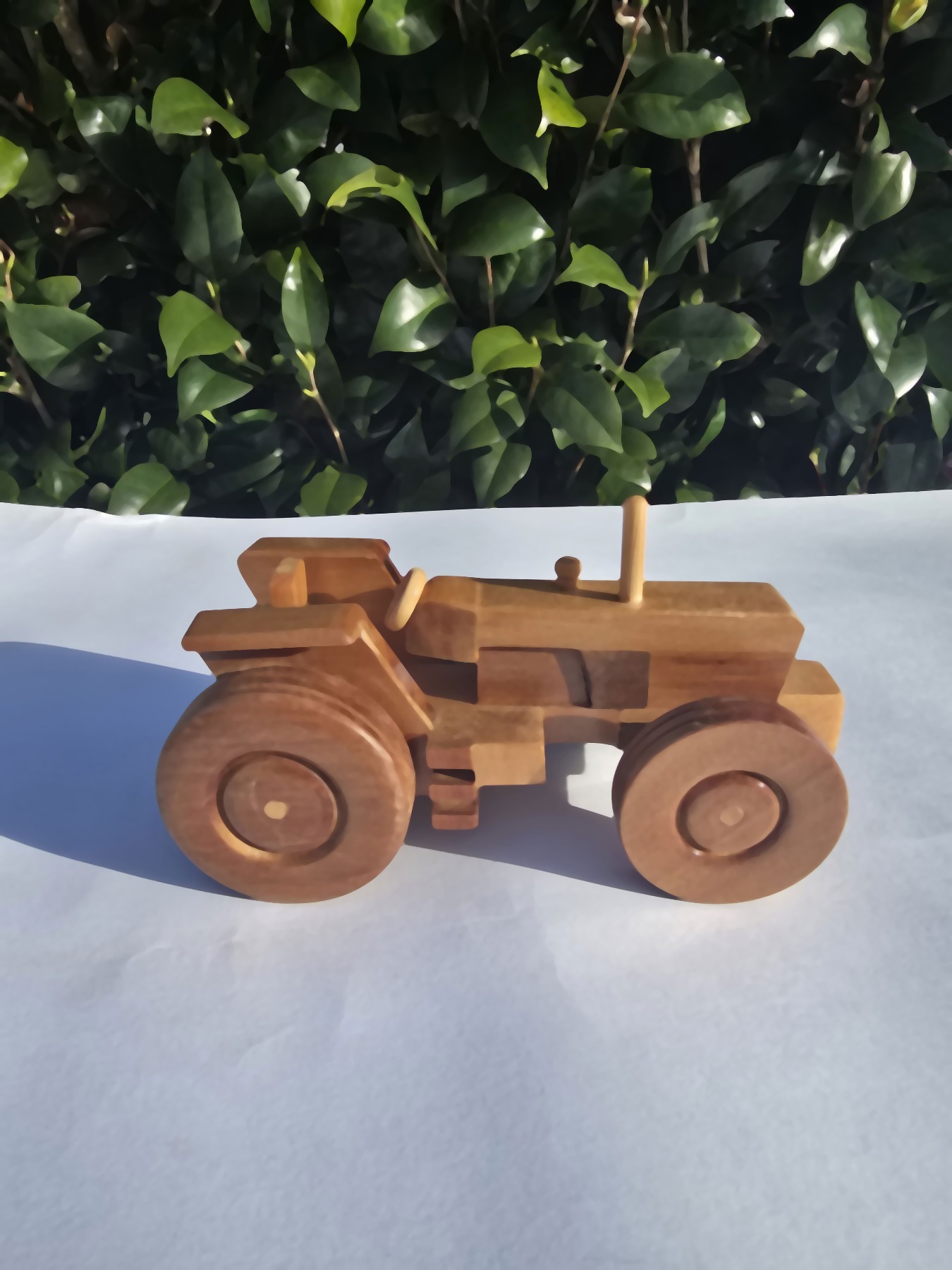
<p>After 10 years handcrafting wooden toys in Whangarei, I've learned firsthand why Montessori educators choose wooden over plastic. It's not just nostalgia — wooden toys actively develop problem-solving skills, creativity, and independent thinking in children.</p>
<h2>How Kids Learn From Wooden Toys</h2>
<p>When parents ask me, "What will my child actually learn from a wooden toy?" — here's what I've seen over a decade of watching children play with what we make: the simpler the toy, the more complex the learning.</p>
<p>Unlike electronic toys that dictate how children should play, wooden toys encourage kids to become problem-solvers as they explore. A simple wooden truck isn't just a truck — it's a delivery vehicle, a construction tool, a bridge component, or whatever your child's imagination creates.</p>
<h2>The Open-Ended Play Advantage</h2>
<p>Open-ended toys — like the wooden blocks, vehicles, and puzzles we craft from native Kauri, Rimu, and Macrocarpa — tend to develop three things well:</p>
<ul>
<li><strong>Problem-Solving:</strong> Children figure out how pieces fit, balance, and interact without preset rules</li>
<li><strong>Creative Thinking:</strong> One toy serves multiple purposes across different play scenarios</li>
<li><strong>Independent Learning:</strong> Kids explore at their own pace without batteries or instructions</li>
</ul>
<h2>What Montessori Schools Look For in Wooden Toys</h2>
<p>We've supplied Montessori schools around New Zealand for years, and their educators consistently choose wooden toys for a few practical reasons:</p>
<h3>1. Sensory Development Through Natural Materials</h3>
<p>Wooden toys provide rich sensory input. The weight, texture, and temperature of natural timber give children tactile feedback that plastic simply doesn't replicate.</p>
<h3>2. Fine Motor Skills That Last</h3>
<p>Encouraging children to manipulate wooden pieces — stacking blocks, fitting puzzle pieces, rolling vehicles — develops the fine motor control needed for writing, drawing, and self-care tasks. Unlike lightweight plastic toys that require minimal effort, our handcrafted wooden toys provide just enough resistance to build real strength and coordination.</p>
<h3>3. Focus and Concentration</h3>
<p>Wooden toys don't flash, beep, or sing. This "boring" quality is actually their superpower. Without electronic distractions, kids learn to focus deeply and sustain attention — skills increasingly rare in our screen-filled world.</p>
<h2>The Problem-Solving Wooden Toys Teach</h2>
<p>Here's what tends to happen when a child plays with a set of wooden blocks versus a plastic toy with predetermined functions:</p>
<table>
<tr><th>Wooden Blocks</th><th>Electronic Plastic Toy</th></tr>
<tr><td>Child decides what to build</td><td>Toy dictates the activity</td></tr>
<tr><td>Trial and error teaches balance</td><td>Success is programmed</td></tr>
<tr><td>Unlimited possibilities</td><td>Limited to preset functions</td></tr>
<tr><td>Encourages imaginative scenarios</td><td>Entertainment is passive</td></tr>
<tr><td>Failure teaches persistence</td><td>Battery dies, toy is useless</td></tr>
</table>
<h2>Age-Appropriate Learning: What Will My Kids Learn at Each Stage?</h2>
<h3>Ages 6-18 Months: Sensory Exploration</h3>
<p>Our teething rings and rattles made from smooth, food-safe native timber introduce babies to:</p>
<ul>
<li>Different textures and weights</li>
<li>Cause and effect (I shake = it makes sound)</li>
<li>Hand-eye coordination</li>
<li>Object permanence</li>
</ul>
<h3>Ages 18 Months - 3 Years: Problem-Solving Begins</h3>
<p>Simple wooden puzzles, stacking toys, and pull-along vehicles teach toddlers:</p>
<ul>
<li>Spatial relationships (big vs. small, in vs. out)</li>
<li>Cause and effect (if I push, it moves)</li>
<li>Basic engineering (stacking creates towers)</li>
<li>Persistence (trying again after failure)</li>
</ul>
<h3>Ages 3-6 Years: Complex Thinking</h3>
<p>Our handcrafted vehicles, building sets, and creative play items help preschoolers develop:</p>
<ul>
<li>Narrative thinking (creating stories through play)</li>
<li>Social skills (collaborative building projects)</li>
<li>Planning and sequencing (building requires steps)</li>
<li>Mathematical concepts (symmetry, patterns, counting)</li>
</ul>
<h2>Why Parents Choose Wooden Over Plastic</h2>
<h3>1. They Last Generations, Not Months</h3>
<p>A rough way to think about the real cost: a $50 plastic toy that lasts 6 months works out to roughly $100 a year if you keep replacing it. A $150 wooden toy that lasts 50+ years works out to about $3 a year. We've had customers bring in toys their children played with decades ago — now being enjoyed by grandchildren. That's the heirloom difference.</p>
<h3>2. Supporting New Zealand Craftsmanship</h3>
<p>Every toy we create in our Whangarei workshop supports local employment and traditional woodworking skills, sustainable use of native NZ timber, and a circular economy where toys are repairable, not disposable.</p>
<h3>3. Environmental Values Children Absorb</h3>
<p>When you give a child a wooden toy that will last their lifetime, you're teaching quality over quantity, respect for natural materials, and the idea of treasuring rather than discarding.</p>
<h2>The Fewer-Better Principle</h2>
<p>Montessori educators call it a "prepared environment" — parents call it sanity. Here's how it works:</p>
<ul>
<li>Start with 5-8 quality wooden toys instead of dozens of plastic ones</li>
<li>Rotate toys every 2-3 weeks to maintain interest</li>
<li>Store extras out of sight (not thrown away)</li>
<li>Watch how deeper, more creative play emerges</li>
</ul>
<h2>Choosing Wooden Toys: What to Look For</h2>
<h3>1. Wood Quality and Safety</h3>
<p>We use native New Zealand timbers — Kauri, Rimu, and Macrocarpa — because they're sustainably sourced, provide beautiful, unique grain patterns, and are dense enough to withstand decades of play. All our finishes are food-safe and non-toxic — no varnishes that chip, no paints with questionable ingredients.</p>
<h3>2. Design Philosophy</h3>
<p>The best wooden toys are simple. A wooden truck with rolling wheels beats an over-detailed, multi-part vehicle every time — simplicity invites imagination.</p>
<h3>3. Appropriate Weight and Size</h3>
<p>Wooden toys should have enough weight to feel substantial but remain safe for the intended age. Our pieces are sized for small hands while heavy enough that children develop real motor strength.</p>
<h2>Shipping Across New Zealand</h2>
<p>We ship wooden toys across New Zealand daily. Orders over $1,000 ship free, and each toy leaves our workshop carefully wrapped in eco-friendly packaging, ready to become part of your family's story.</p>
<h2>Start With One Quality Piece</h2>
<p>You don't need to overhaul your entire toy collection overnight. Many families start with one wooden vehicle or puzzle set, watch how their child engages with it, and gradually add more. The transformation isn't always immediate, but it's consistent: deeper focus, more creative play, and toys that become treasured family pieces rather than landfill waste.</p>
<h2>About Poppa's Wooden Creations</h2>
<p>Since 2015, we've been handcrafting wooden toys and kitchenware from native New Zealand timbers in our Whangarei workshop. Our toys are supplied to schools around the country and loved by families who value quality, sustainability, and heirloom craftsmanship.</p>
<p><a href="/reviews">Read our reviews</a> | <a href="/contact">Visit our workshop</a></p>